Training IntelligenceIssue No. 024 · NBD Powerlifting
RIR: TRAIN HARDER WITHOUT BURNING OUT WITH REPS IN RESERVE
Every lifter who has ever hit a wall mid-cycle, felt inexplicably flat on a heavy day, or snapped something that shouldn't have snapped was ignoring one number. That number is RIR — and it is the most honest feedback your body gives you.
Training ScienceAuto-RegulationStrength ProgrammingPowerlifting India
Reps in Reserve
The RIR Method — A Complete Guide
The One-Line Answer
RIR — Reps in Reserve — is how many more reps you could have completed when you racked the bar, and it is the direct inverse of RPE: RIR = 10 − RPE, so RIR 2 is RPE 8, RIR 1 is RPE 9, and RIR 0 is failure. Most lifters find it easier to use than RPE because “I had two reps left” is more concrete to track honestly than rating effort on a scale. The principle behind it is auto-regulation: setting load by what you can actually do today rather than a number written in a spreadsheet three weeks ago, because a one-rep max moves 5–12 per cent day to day with sleep, nutrition, stress and accumulated fatigue. On main movements, RIR 2 is the highest intensity most lifters should reach.
WHAT IS REPS IN RESERVE AND WHY IT CHANGES HOW YOU TRAIN
RIR is not a soft metric. It is a precise, science-backed tool that the world's best strength coaches use to keep athletes progressing for years without breaking down.
Every time you finish a set, your body knows something your program does not: how many more reps you actually had left. That number — your Reps in Reserve — is the most accurate real-time measure of training intensity available to you. It costs nothing, requires no equipment, and once you learn to read it accurately, it becomes the single most powerful variable in your programming.
RIR is the direct inverse of the RPE scale. RPE 8 equals RIR 2. RPE 9 equals RIR 1. RPE 10 equals RIR 0 — absolute failure. Both tools measure proximity to failure, but many lifters find RIR more natural to use because counting reps you have left is more concrete than rating effort on a scale. "I had 2 reps left" is easier to track honestly than "that felt like an 8."
The principle behind RIR is called auto-regulation — adjusting training load based on actual performance capacity rather than a number written in a spreadsheet three weeks ago. Your 1RM fluctuates by 5-12% day to day based on sleep, nutrition, stress, and accumulated fatigue. A program built on fixed percentages assumes you are always the same athlete. RIR acknowledges that you are not.
Key Principle
RIR and RPE are mathematically linked: RIR = 10 − RPE. A set at RPE 7 (RIR 3) means you stopped with 3 reps in the tank. A set at RPE 9 (RIR 1) means you had one rep left. Learning one system makes the other immediately intuitive.
The reason RIR matters so much for powerlifters specifically is the nature of the sport. You train the same three movements, in the same patterns, week after week, year after year. The cumulative fatigue is enormous. Without a reliable way to gauge daily readiness and adjust load accordingly, most lifters either chronically undertrain — leaving gains on the table — or chronically overtrain, accumulating fatigue that eventually surfaces as an injury at the worst possible moment.
"The lifter who finishes every set knowing exactly how many reps they had left is the lifter who stays healthy, keeps progressing, and competes year after year."
— NBD Powerlifting
RIR vs RPE — Quick Reference
RIR 0 = RPE 10 — Absolute failure, zero reps left RIR 1 = RPE 9 — 1 rep left, near-maximal effort RIR 2 = RPE 8 — 2 reps left, strong working set RIR 3 = RPE 7 — 3 reps left, productive but controlled RIR 4+ = RPE 6 and below — Warm-ups, technique work
The Complete RIR Scale
RIR 0 TO RIR 5+ — WHAT EVERY NUMBER MEANS FOR YOUR TRAINING
RIR
Equivalent RPE
Training Zone
Best Used For
0
RPE 10 Absolute Failure
Maximum effort — zero reps left. Bar moves as slowly as possible while still completing the rep.
Avoid on compound lifts. Acceptable on isolation exercises like curls or leg extensions where injury risk is low.
1
RPE 9 Near Maximal
One rep left in the tank. The last rep completed was genuinely difficult and technique may begin to break down.
Competition openers and near-maximal singles in peaking phases. Sparingly — high CNS cost and injury risk.
2
RPE 8 Top Working Sets
Two reps left. The rep is hard but form is solid. This is the highest intensity most lifters should reach on main movements.
Top sets in strength phases. The most common target for intermediate and advanced powerlifters on squats, bench, and deadlifts.
3
RPE 7 Strength-Hypertrophy
Three reps left. Challenging but controlled. Bar speed is still relatively crisp on competition movements.
Back-off sets after top sets. Primary working sets in hypertrophy blocks. Most productive zone for volume accumulation.
4
RPE 6 Hypertrophy Volume
Four reps left. Moderate effort. This is where high-rep accessory work and hypertrophy-focused sets tend to land.
Accessory movements, higher-rep sets (10-15), and early-week volume work when fatigue management is a priority.
5+
RPE 5 and below Warm-Up Zone
5 or more reps left. Minimal exertion. The weight feels light and movement is automatic.
Warm-up sets, technique practice, and primer sets early in a session. Not productive for strength adaptation.
Programming
Applying RIR to Your Training
HOW TO ACTUALLY USE RIR IN YOUR PROGRAMME
Knowing the RIR scale is one thing. Building it into your daily training decisions is what separates lifters who progress year after year from those who plateau and break down.
The most practical way to use RIR is as a load-selection guide. Before your first working set, you have a target RIR — say RIR 2 for a top set of 3. You load a weight you expect will land there, perform the set, and then honestly assess: how many more reps did you actually have? If you had 4 left, the weight was too light. If you were at RIR 0, you overshot. Adjust your next set accordingly.
This self-correction loop is the core of auto-regulated training. Over weeks and months, your ability to predict RIR before a set becomes extremely accurate — typically within 0.5 reps for experienced lifters. That accuracy gives you a real-time readiness signal that no heart rate monitor or HRV device can match for strength training purposes.
The Daily RIR Check
Start every session with a reference set — a weight you know well at a specific rep count. If it feels harder than usual (lower RIR than expected), your readiness is compromised. Reduce loads by 5-10% across the session. This single habit prevents more overtraining injuries than any deload protocol.
For programming, a standard strength block might prescribe: Week 1 — all sets at RIR 3, Week 2 — RIR 2, Week 3 — RIR 1, Week 4 — deload at RIR 4+. This progressive proximity to failure is called a fatigue-ramp, and it is the backbone of how elite coaches structure peaking cycles. The genius of the RIR system is that the same structure works across athletes of completely different strength levels because it scales to individual capacity automatically.
One critical nuance: RIR estimates for sets of 1-3 reps are less reliable than for sets of 5-10. On singles and doubles, the margin between RIR 1 and RIR 0 is thin and psychologically difficult to assess accurately. This is why experienced lifters combine RIR with bar-speed feedback — a noticeably slower bar means RIR is lower than perceived. Use both signals together on near-maximal attempts.
RIR By Training Goal
Maximum Strength (1-5 rep range): Top sets: RIR 1-2 • Back-off sets: RIR 2-3
Your belt signals RIR. Most experienced lifters report that belted sets run approximately RIR 0.5-1 higher than unbelted at the same weight — the belt improves brace quality, which genuinely changes performance. Factor this into your RIR estimates when programming belted and unbelted sessions. Read our complete RPE guide for the full picture on auto-regulation.
The Research
WHY RIR WORKS — THE SCIENCE BEHIND THE METHOD
01
Proximity to Failure Drives Adaptation
Research consistently shows that muscle fibre recruitment and mechanical tension — the primary drivers of strength adaptation — increase significantly as a set approaches failure. Training at RIR 0-3 ensures high-threshold motor units are activated on every working set. Sets at RIR 5+ rarely provide sufficient stimulus for strength gains in trained athletes.
02
RIR Accuracy Improves With Experience
Studies on self-reported proximity to failure show that beginners overestimate RIR by 2-4 reps on average — they think they have 4 reps left when they actually have 1. Intermediate and advanced lifters are accurate to within 0.5-1 rep. This is why RIR-based programming is most effective for lifters with at least 12-18 months of consistent training experience.
03
Auto-Regulation Outperforms Fixed Load
A 2022 meta-analysis of auto-regulated versus percentage-based strength training programmes found that RIR and RPE-guided training produced superior strength gains over 8-16 week cycles, particularly in the final 4 weeks of a peaking block. The primary mechanism is simple: on high-readiness days, RIR training allows harder effort than a fixed percentage would permit.
04
RIR Reduces Overtraining Injury Risk
By capping maximum effort on any given day based on actual readiness rather than prescribed load, RIR training naturally moderates cumulative stress. Lifters using RIR-based programmes report significantly fewer non-contact soft tissue injuries compared to fixed-percentage programmes — particularly in tendons and connective tissue that recover more slowly than muscle.
Avoid These Errors
THE MOST COMMON RIR MISTAKES LIFTERS MAKE
01
Overestimating RIR on Heavy Sets
The most common mistake — stopping at what feels like RIR 3 when you actually had RIR 1. Ego protection kicks in on heavy sets. Combat this by occasionally pushing a set further than planned to calibrate your estimates against reality.
02
Using RIR 0 on Compound Lifts
Training squats, deadlifts, or bench to absolute failure is unnecessary and dangerous. The marginal adaptation gain is not worth the injury risk, the CNS fatigue cost, or the technique breakdown that occurs on the final rep of a true failure set.
03
Ignoring Session-to-Session Variation
The same weight at the same rep count can feel like RIR 3 one day and RIR 1 three days later. This is normal — it is your body communicating readiness. The correct response is to adjust load, not push through and accumulate fatigue.
04
Applying RIR Without a Reference Point
RIR estimates need anchoring to real data. If you have never actually taken a set to failure in a controlled setting, your RIR estimates are guesswork. Periodically test your actual maximum on isolation movements to calibrate your perception.
05
Using the Same RIR Target Every Session
RIR targets should change across a training block — starting higher early in a cycle and decreasing progressively as you approach competition or a peak. A flat RIR target week after week is the same mistake as flat percentage training.
06
Forgetting That Fatigue Masks RIR
Accumulated fatigue within a session lowers your effective RIR. Your third working set at the same load as your first will genuinely be at a lower RIR — not because you got weaker, but because fatigue is real. Account for this by slightly reducing load on later sets or accepting a higher RIR target.
07
Not Pairing RIR With Gear Consistently
If you sometimes train belted and sometimes not, your RIR baselines are mixed data. Establish clear conventions: belt goes on at RIR 2 and below on main movements. This consistency makes your RIR log far more useful for future programming.
RIR stands for Reps in Reserve — the number of reps you could still complete after stopping a set. RPE (Rating of Perceived Exertion) is a 1-10 effort scale. They measure the same thing from opposite directions: RPE 8 equals RIR 2. Many lifters find RIR more intuitive because counting reps remaining is more concrete than rating effort. Both are valid auto-regulation tools and work best used together.
For maximum strength development keep working sets between RIR 1 and RIR 3. RIR 2 is the optimal target for most strength-focused training — close enough to failure to drive neurological and structural adaptation, far enough to maintain technique quality and bar speed. Top singles and competition preparation can go to RIR 1 or even RIR 0 on openers, but this should be reserved for peaking phases only.
Rarely, and almost never on compound movements. Training squats, deadlifts, or bench press to absolute failure (RIR 0) produces disproportionate CNS fatigue, elevates injury risk significantly — especially in tendons and connective tissue — and teaches poor movement patterns as technique breaks down under maximal fatigue. Reserve failure sets for low-risk isolation movements and use them sparingly to calibrate your RIR estimates on heavier sets.
The best calibration method is occasional push sets — periodically taking a set beyond your planned stopping point to see how many reps you actually had. If you planned to stop at RIR 2 and pushed 4 more reps, your estimates are running 4 reps high. Most beginners overestimate RIR by 2-4 reps. Experienced lifters are accurate to within 0.5-1 rep. Bar speed is a useful secondary signal — visibly slower bar equals lower RIR than you may perceive.
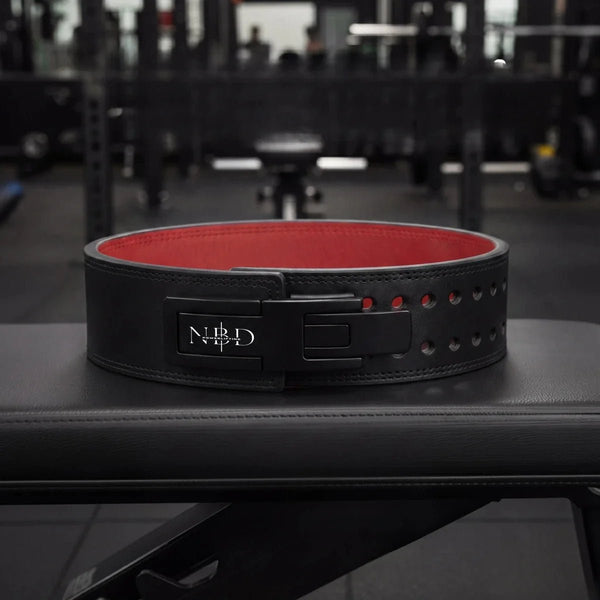
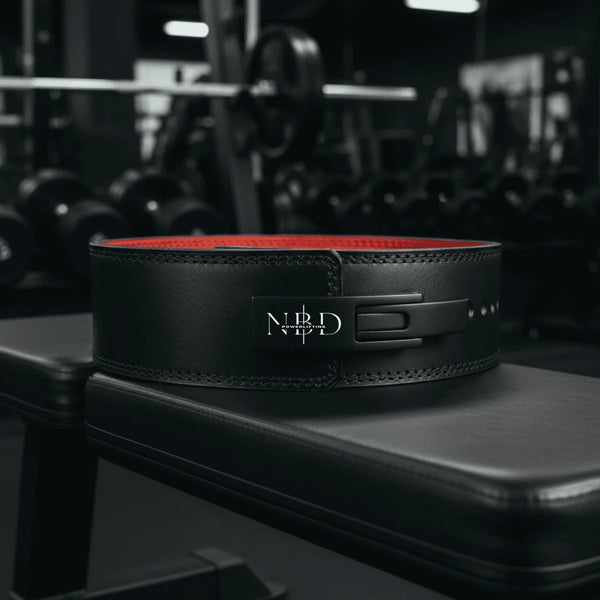
RIR is one of the most reliable cues for lever belt use. Put your belt on when your sets approach RIR 2 or lower — at this point, intra-abdominal pressure becomes a meaningful factor in spinal protection and performance output. A quality leather belt like the NBD 13mm Dual Pro allows you to brace maximally, which measurably improves performance and changes how a set feels — experienced lifters often find belted RIR runs 0.5-1 point higher than unbelted at equivalent loads.
RIR asks you to judge your own effort accurately, which is exactly where a second, trained pair of eyes helps most. An NBD strength assessment reviews your actual lifts on video against a coach's checklist — a starting point if your RIR numbers do not match what is actually happening on the bar.
TRAIN SMARTER. LIFT HEAVIER.
RIR tells you exactly how hard to push. NBD gear gives you the support to push that hard safely and consistently. Competition-standard leather belts, knee sleeves, wrist wraps, and lifting straps — engineered in India for serious lifters.
NBD Powerlifting is an Indian manufacturer of competition-grade powerlifting equipment — lever belts, knee sleeves, wrist wraps and lifting straps — serving 15,500+ lifters across India. Written by Karman Singh, who founded NBD in Sirsa, Haryana in 2014.
The NBD Belts
Built and shipped from India, for lifters who never back down.
Cash on Delivery is available. COD charges are extra — they
are not part of the price on the product page and are added at checkout, on
top of your order value.
COD charge by order value
Order value
COD charge
Up to ₹3,000
₹250
₹3,001 – ₹5,000
₹400
₹5,001 – ₹7,000
₹600
₹7,001 – ₹10,000
₹800
₹10,001 – ₹15,000
₹1,200
₹15,001 – ₹20,000
₹1,500
₹20,001 – ₹30,000
₹2,000
Above ₹30,000
On WhatsApp
How a COD order is processed
Your order is confirmed on WhatsApp.
Once you place a COD order our team messages you on WhatsApp to confirm the
item, the size and the delivery address.
The COD charge is paid in advance, as the shipping charge.
Only the COD charge shown above is paid upfront. The rest of your order
value is still paid in cash to the courier at your door.
Unpaid COD shipping is cancelled within 24 hours.
If that advance shipping payment does not reach us within 24 hours of the
WhatsApp confirmation, the order is cancelled.