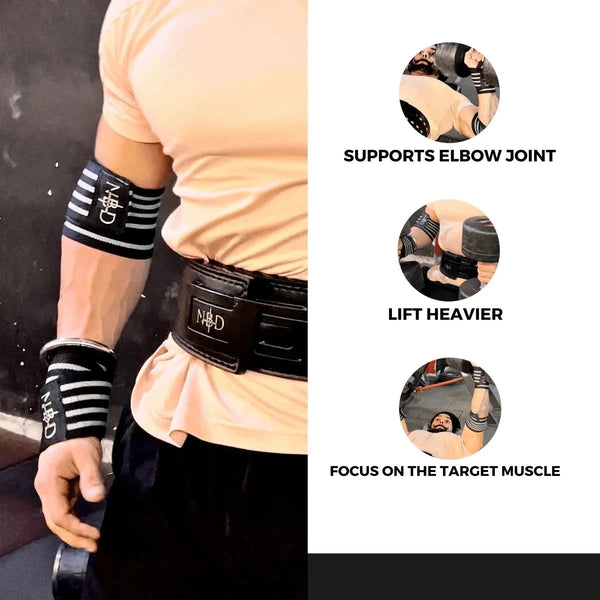
Elbow wraps are the least understood piece of support gear in the gym, and the reason is simple: almost nobody selling them will tell you they are a training tool rather than a competition one. That single fact changes how you should choose a pair, how you should use them, and whether you need them at all.
The One-Line Answer
Buy elbow wraps if heavy pressing is a regular part of your training and your elbows have started telling you about it. Do not buy them expecting to wear them on a competition platform.
Everything below is about working out which side of that line you are on, and how to get a pair that still works in a year.
What an Elbow Wrap Actually Does
Elbow pain is the injury that quietly ends bench progress. It rarely arrives as an event. It builds across weeks of heavy pressing, close-grip work and high-volume triceps training, and by the time it hurts on your warm-up sets you have already lost a training block.
An elbow wrap does three things about that, and it is worth being precise, because two of them are frequently oversold:
- Warmth. A wrapped joint stays warm between sets. This is the least glamorous benefit and probably the most useful one, particularly in an air-conditioned gym or a cold winter morning session.
- Compression. Firm, even pressure around the joint. Lifters consistently report that a compressed elbow feels more stable and less irritable under load.
- A little rebound at the bottom. Wound tight, elastic stores some energy in the stretched position and gives a fraction of it back. This is real, but it is small, and any source quoting you a specific number of kilos is guessing.
What an elbow wrap does not do is fix anything. It does not repair a tendon, correct your bar path, or make a badly programmed pressing week survivable. It buys you comfort and confidence while you sort those out.
Elbow Wraps vs Elbow Sleeves
These get used interchangeably and they are genuinely different products solving the same problem in opposite ways.
| Factor | Elbow Sleeves | Elbow Wraps |
|---|---|---|
| Construction | Fixed neoprene tube, pull on | Long elastic band, wound on |
| Tension control | Whatever the size gives you | You set it, every set |
| Support at maximal loads | Moderate | Higher |
| Speed between sets | On once, forget them | Re-wrapping takes time |
| Wear all session? | Yes, comfortably | Only at moderate tension |
| Best for | Volume pressing, warmth, convenience | Heavy singles, adjustable support |
If you want one sentence: sleeves are for the whole session, wraps are for the sets that matter. Lifters who press seriously usually end up with both, but there is no reason to buy both at once. Start with whichever matches the problem you actually have.
Are Elbow Wraps Allowed in Competition? The Honest Answer
This is the section most buying guides skip, and it is the one that most often costs someone money.
Under IPF rules, no. The IPF Technical Rulebook specifies permitted personal equipment in considerable detail — wrist wraps may not exceed 1m in length and 8cm in width, knee sleeves may not exceed 7mm thickness and 30cm length — and elbow wraps and elbow sleeves do not appear on that list at all. Equipment that is not listed as permitted is not permitted.
Other federations vary, and are still restrictive. USPA, as one example, does allow elbow sleeves — but on squat and deadlift only, never on bench press, capped at 20cm length and 7mm thickness, and explicitly with no velcro or adjustment mechanism. A velcro-fastened elbow wrap does not meet that description in any division.
So the practical position for an Indian lifter is this: elbow wraps are a training tool. They protect your pressing across a training block so you arrive at the meet healthy. They stay in the bag on meet day. If you compete, read your own federation's current rulebook and equipment list rather than trusting any product page, including this one.
NBD does not claim federation approval on any product, and NBD is not currently listed on any federation's approved-equipment register. Where a dimensional specification exists we state it and build to it. Where equipment is simply not permitted, as here, we say so.
What to Look For in a Pair
- Length, honestly stated. A wrap needs enough material for several overlapping passes above and below the joint. Short wraps run out halfway and you end up with coverage but no tension.
- Width that suits the joint. Around three inches is the useful range. Too narrow and the wrap digs in as a band rather than supporting an area; too wide and it bunches when you bend the arm.
- Elastic that recovers. This is the whole product. Cheap wraps feel great in week one because they are soft, then stretch out permanently and never hold tension again. Softness on day one is a warning sign, not a selling point.
- Velcro that survives. The single most common failure point. Wide, well-sewn velcro that still grips after a hundred sessions is the difference between a pair that lasts a year and a pair that lasts a season.
- Reinforced stitching at the ends. The ends take all the load when you pull tension. That is where a wrap tears first.
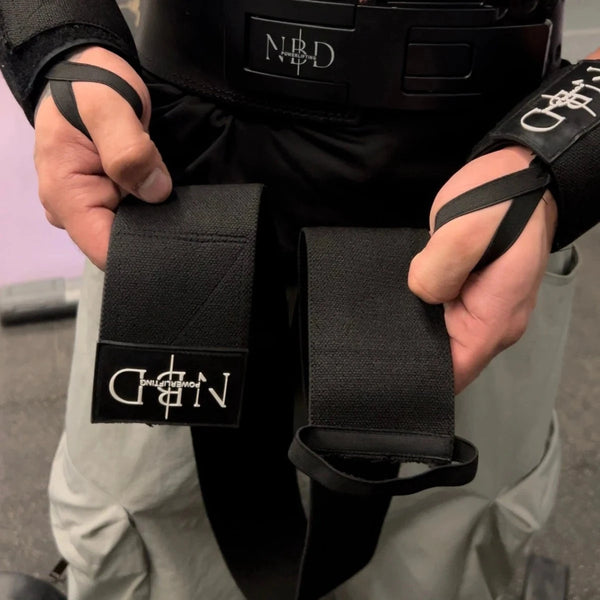
- A loop. Small detail, real difference — a loop lets you anchor the wrap and apply proper tension one-handed, which matters because you are wrapping your own arm.
The NBD Elbow Wraps Range
NBD manufactures its wraps rather than rebranding stock imports, which is why the specification is published rather than vague.
- NBD Elbow Wraps — 3 inches wide and 38 inches long, high-grade elastic, reinforced stitching, extra-wide velcro fastening and an extra loop for one-handed application. The straightforward choice for a lifter adding elbow support to a pressing programme.
- NBD Elbow Wraps ‘Elite Series’ — the Black Series construction, built around a denser elastic and reinforced stitching for lifters who press heavy often and want the tension to hold across a full training block.
If you want warmth and compression across a whole session rather than adjustable tension on heavy sets, look at NBD Elbow Sleeves in 7mm neoprene instead. Different tool, same joint.
How to Wrap Your Elbows
- Bend the arm slightly. Never wrap a locked-out straight arm. Wrapped straight, the wrap bites hard the moment you flex and you will take it off within a set.
- Anchor below the joint. Start on the forearm, a few centimetres below the elbow, and secure the first pass.
- Spiral upward, overlapping by about half. Keep tension firm and, more importantly, even. Uneven tension creates a pressure point that hurts long before the set does.
- Cross the joint itself two to three times. This is where the support actually comes from. Everything below and above is anchoring.
- Finish above the joint and secure the velcro. Press it down along its full length rather than just the corner.
- Test it. Bend and straighten the arm fully. You want firm resistance, not pain, and no tingling in the hand.
Four Mistakes Worth Avoiding
- Wearing them for everything. Wraps on for the whole session, every session, means the joint never adapts to unsupported loading. Use them for the heavy pressing work, not for your warm-ups and accessories.
- Wrapping over pain and calling it solved. If it hurts on warm-ups, the wrap is hiding a signal you need. Get it assessed.
- Wrapping straight-armed. The most common technical error, and the reason most people who "tried elbow wraps once" never went back.
- Machine washing them. Heat and agitation destroy elastic recoil and clog the velcro permanently. Hand wash cold, air dry away from direct heat.
Who Should Not Buy Elbow Wraps
Worth saying plainly, because it is not in most brands' interest to say it. Skip them for now if you are in your first few months of training, if your pressing volume is modest, if your elbows are not bothering you, or if you have not yet bought a belt. A belt affects far more of your training than elbow support does, and a beginner with sore elbows usually has a programming or technique issue that a wrap will only quieten.
And if you have persistent, sharp elbow pain that is present outside the gym, that is a matter for a physiotherapist or a doctor, not a support wrap.
Making Them Last
Hand wash in cold water with mild soap. Air dry away from direct heat and never a dryer. Close the velcro before storing so it does not collect lint, which is what kills the grip. Unroll them rather than leaving them balled up damp in a gym bag — in Indian humidity that single habit is worth an extra season.
Elbow Support, Built to Last a Training Block
Manufactured by NBD, not rebranded. Reinforced stitching, wide velcro and elastic that holds its tension. Trusted by 15,500+ lifters across India, with free pan-India shipping and COD available. Not sure whether you want wraps or sleeves? Message the team and describe when your elbows bother you.
SHOP NBD ELBOW WRAPS →Frequently Asked Questions
Are elbow wraps allowed in powerlifting competition?
Generally no. The IPF Technical Rulebook lists permitted personal equipment in detail, including wrist wraps and knee sleeves with exact dimensional limits, and elbow wraps and elbow sleeves do not appear on that list at all. Other federations are more permissive but still restrictive — USPA allows elbow sleeves on squat and deadlift only, never on bench press, capped at 20cm and 7mm with no velcro or adjustment mechanism. Treat wraps as a training tool and check your own federation's current rulebook.
What is the difference between elbow wraps and elbow sleeves?
A sleeve is a fixed neoprene tube you pull on for consistent warmth and light compression across a session. A wrap is a long elastic band you wind on, so you set the tension every time — moderate for volume, tight for a heavy single. Wraps give more support and control, sleeves give more convenience.
Do elbow wraps help with elbow pain from bench press?
They help you keep training while you address the cause, which is not the same as fixing it. Compression and warmth reduce the sensation of pain and most lifters press more comfortably with them on. If pain is present on warm-up sets rather than only at maximal lockout, get it looked at properly rather than wrapping over it week after week.
How tight should elbow wraps be?
Tight enough that the joint feels supported, loose enough that your hand does not tingle. Wrap with the arm slightly bent, never locked straight. Moderate tension for working sets across a session, tight for a maximal single and off immediately afterwards.
Can beginners use elbow wraps?
They can, but most beginners are better served buying a belt first. Elbow wraps earn their place when pressing volume or load is high enough that the joint starts complaining. Three months into training, sore elbows are usually a technique or volume problem that a wrap will only mask.
How long do elbow wraps last?
It depends on the elastic and the velcro, not on how often you train. Elastic that loses its recoil and velcro that clogs with lint are the two failure points. Hand wash cold, air dry away from heat, and store them with the velcro closed.
Related reading: Choosing your first powerlifting kit · Wrist wraps for pressing support · All NBD straps, wraps and sleeves · Best powerlifting belt in India 2026