Knee sleeves and knee wraps are not two grades of the same product, and choosing between them is not a budget decision. They are different tools with different jobs, different rules, and different consequences if you pick wrong. One line in the IPF rulebook settles the question for most Indian lifters before comfort or preference ever comes into it.
The One-Line Answer
Buy sleeves. Buy wraps only if you compete in an equipped division, or you genuinely train maximal singles.
That covers the large majority of people asking this question. The rest of this explains why, and how to tell if you are one of the exceptions.
The Rule That Decides It for Most People
This is the part that rarely makes it into a comparison article, and it is the part that matters most if you have any intention of competing.
Under IPF rules, knee wraps not exceeding 2 metres in length and 8 cm in width may be worn only in competitions designated as Equipped. The Classic division — raw lifting, which is what the overwhelming majority of Indian competitors do — does not permit them at all.
Knee sleeves, at a maximum thickness of 7 mm and a maximum length of 30 cm, are permitted in both. And combining wraps and sleeves is strictly forbidden — you wear one or the other, never both.
So if you are a raw lifter who intends to compete, training your heavy squats in wraps means training in equipment you cannot use on the day. Your wrapped squat and your competition squat become two different lifts, and only one of them counts.
NBD builds to these dimensional specifications and states them plainly. NBD is not currently listed on any federation's approved-equipment register and does not claim to be. Rules also vary between federations, so read the current rulebook and equipment list for the one you compete under.
Sleeves vs Wraps, Side by Side
| Factor | Knee Sleeves | Knee Wraps |
|---|---|---|
| What it is | Neoprene tube, pull on | Long elastic bandage, wound on |
| Primary job | Warmth and compression, all session | Maximum rebound on one attempt |
| IPF Classic (raw) | Permitted | Not permitted |
| IPF Equipped | Permitted | Permitted, within limits |
| Wear between sets? | Yes, leave them on | No — off immediately after |
| Setup time per set | None | Minutes, often with help |
| Useful for sets of five? | Yes | Not really |
| Who it suits | Nearly everyone | Equipped competitors, max-single work |
What Each One Is Actually Doing
A sleeve compresses. Dense neoprene wrapped around the joint keeps it warm from your first working set, holds the tissue firm, and gives a small amount of rebound. Its real value is consistency — the knee feels the same on set one as on set five, and you stop losing your first two working sets getting the joint ready.
A wrap stores energy. A long elastic bandage wound under high tension stretches as you descend and returns that energy as you come out of the bottom. That is a materially different mechanism from compression, and it is why a wrapped squat is genuinely stronger than an unwrapped one. It is also why it is uncomfortable, restrictive, and impossible to wear for a session.
Anyone quoting you a specific number of kilos that wraps add is guessing. The effect is real and it depends entirely on the wrap job, the tension and the lifter.
Buy Wraps If…
- You compete in an equipped division, or plan to
- You regularly train true singles at or near your maximum, not sets of three to five called heavy
- You are peaking for a meet where wraps are permitted and you need to practise the wrap job itself — because wrap tension is a skill and meet day is the wrong place to learn it
- You already own sleeves, use them, and have hit the ceiling of what they give you
If none of those describe you, wraps will sit in your bag. They are not worth the minutes it takes to apply them for anything below a near-limit attempt.
How to Wrap a Knee
If you do need wraps, the wrap job matters as much as the product. Under IPF rules the wrap may not extend more than 15 cm above or 15 cm below the centre of the knee joint, and the total covering width may not exceed 30 cm — so wrapping halfway up the thigh is not just uncomfortable, it is outside the limit.
- Start with the leg slightly bent, never locked straight.
- Anchor below the kneecap and secure the first pass.
- Spiral upward in overlapping passes, roughly half over each previous turn, keeping constant tension. A diagonal or figure-eight pattern both work.
- Pull hardest across the joint itself — that is where the stored energy comes from.
- Finish above the knee and tuck the end securely under the last pass or close the velcro along its full length.
- Wrap immediately before the attempt and unwrap straight after. Tight wraps restrict circulation. That is how they work, and that is why they come off.
Practise the tension in training long before you rely on it for a meet attempt. A badly wrapped knee gives you the discomfort without the rebound.
A Note on "Knee Caps"
In Indian gyms, "knee cap" gets used for everything from a proper neoprene lifting sleeve to a thin elasticated support from a chemist. They are not the same product and the difference costs people money.
A lifting knee sleeve is dense neoprene, typically 5mm or 7mm, that meaningfully compresses the joint. A thin elasticated knee cap or support gives warmth and the feeling of being held, and essentially nothing under a loaded barbell. If you are squatting heavy, ask for the thickness in millimetres rather than the name on the packet.
So Which Should You Own?
Start with sleeves. They cover every session you train, they are permitted in every IPF division, and they are the piece of knee equipment you will actually use. Wear them out before you consider anything else.
Add wraps when your competition division permits them and your training genuinely lives at maximal singles. Owning both is a real setup for an equipped competitor and an expensive shelf for everyone else.
The NBD Range
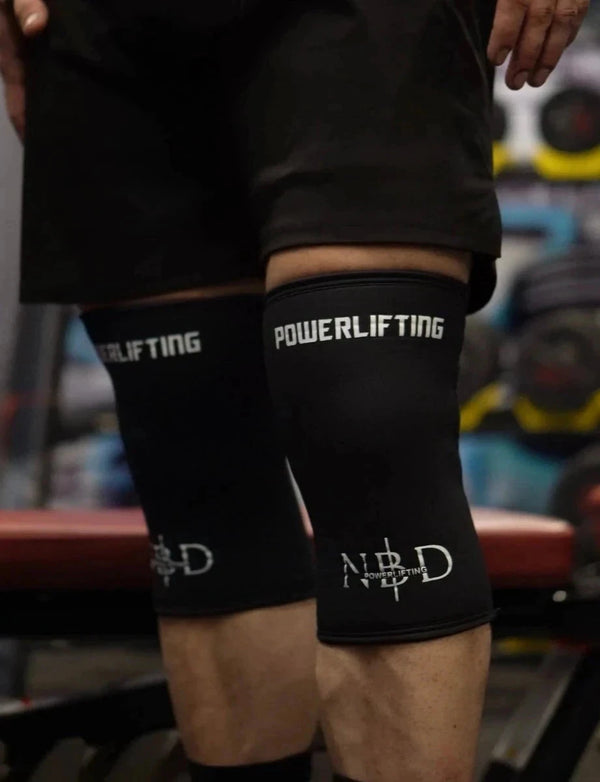
- NBD Knee Sleeves 7mm — the powerlifting standard in premium neoprene, sized S to XL and sold as a pair. The default recommendation for a lifter squatting heavy.
- NBD PRO 7mm Powerlifting Knee Sleeves — the PRO construction at the same 7mm.
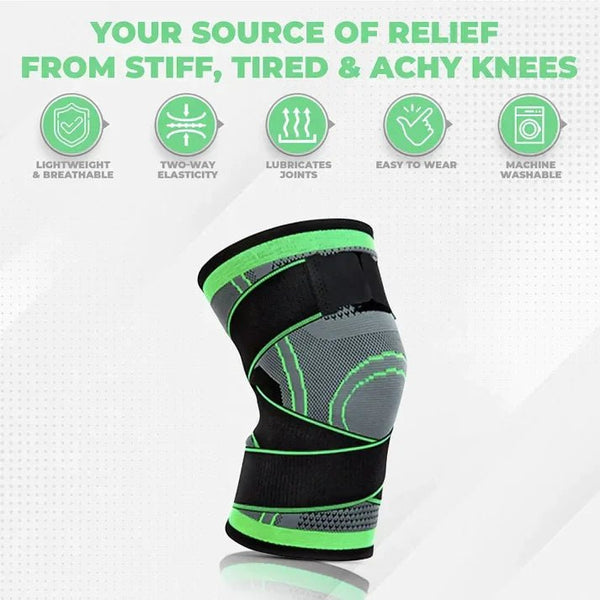
- Compression Knee Sleeves with Straps — thinner and more mobile, for mixed training, higher-rep work and general gym use where stiffness is a nuisance rather than a feature.
- NBD Knee Wraps, Heavy Duty Bandages and NBD Knee Wraps Heavy Duty, Black Series — high-tension elastic with a velcro closure, for maximal attempts and equipped competition.
Care, and Why It Decides Lifespan
Sleeves: hand wash cold with mild soap, air dry away from direct heat. Never a washing machine and never a dryer — heat permanently destroys neoprene compression and it does not come back. Turn them inside out after training rather than leaving them balled up damp.
Wraps: unroll them fully after every session so the elastic does not set in a coiled shape. Spot clean and air dry. A wrap that has been stored coiled and damp loses the tension that is the entire point of owning it.
Start With Sleeves. Add Wraps If You Need Them.
7mm neoprene at 30cm dimensional specification, sold as a pair, built to hold compression past the first training block. Trusted by 15,500+ lifters across India, with free pan-India shipping and COD available. Unsure on sizing? Message the team with your measurements before you order.
SHOP NBD KNEE SLEEVES →Frequently Asked Questions
Should I buy knee sleeves or knee wraps?
Sleeves, for almost everybody. They are a training tool you wear across a whole session, and under IPF rules they are permitted in both Classic and Equipped. Wraps are a maximal-attempt tool permitted only in Equipped. If you train raw, or do not compete, sleeves fit how you actually lift.
Are knee wraps allowed in raw powerlifting?
Not under IPF rules. Wraps up to 2 m long and 8 cm wide may be worn only in competitions designated as Equipped; Classic does not permit them. Sleeves up to 7 mm thick and 30 cm long are permitted in both, and combining the two is strictly forbidden. Federations differ — check yours.
Do knee wraps add weight to your squat?
Wound tight, they store elastic energy on the descent and return part of it out of the bottom, so a wrapped squat is genuinely stronger. How much depends on the wrap job, the tension and the lifter, which is why any specific kilo figure is a guess. The effect only appears when the wrap is truly tight.
Can I wear knee wraps for my whole training session?
No, and trying is the classic mistake. At working tension they restrict circulation and become uncomfortable within minutes. They go on before a heavy attempt and come off straight after. If you want support you can leave on all session, that is a sleeve.
Is a knee cap the same as a knee sleeve?
The words get used interchangeably in Indian gyms and it causes real confusion. A lifting sleeve is dense neoprene, usually 5mm or 7mm, that compresses the joint. A thin elasticated knee cap gives warmth and little else under a loaded barbell. Ask for the thickness in millimetres.
Should I own both?
Only if you compete equipped or genuinely train maximal singles. For a lifter doing sets of five, wraps sit unused. Buy sleeves first, wear them out, and add wraps if your training or your federation calls for them.
Related reading: Best knee sleeves for squats in India 2026 · 5mm vs 7mm knee sleeves · Knee sleeve size guide · NBD knee wraps