The thickness question gets answered badly almost everywhere, because the answer most brands give is "7mm, obviously" — and 7mm is what they most want to sell you. The truth is that thickness is a fork in the road, not a quality ladder. Pick the wrong branch and you own a pair of sleeves you avoid using.
The One-Line Answer
Buy 7mm if heavy squatting is the centre of your training. Buy 5mm if it is not.
That is genuinely the whole decision for most lifters. The rest of this guide is for working out which of those two descriptions is actually you — because plenty of people who call themselves powerlifters train in a way that is far better served by 5mm, and plenty of general gym-goers squat heavily enough to want 7mm.
What the Millimetres Actually Change
A knee sleeve is dense neoprene doing three jobs: keeping the joint warm, compressing it, and storing a little elastic energy that comes back at you out of the bottom of a squat. Thickness scales all three at once — and scales the downsides with them.
| Factor | 5mm | 7mm |
|---|---|---|
| Compression | Light to moderate | Firm — the powerlifting standard |
| Rebound out of the hole | Negligible | Real and repeatable |
| Joint warmth | Moderate | High — warm from set one |
| Freedom of movement | High | Restrictive by design |
| Heat build-up | Manageable all session | Hot — noticeable in Indian summers |
| Getting them on | Straightforward | A fight for the first few sessions |
| Wear all session? | Yes, comfortably | Most lifters take them off between exercises |
| IPF thickness limit | Inside the limit | At the limit — 7mm is the maximum |
Buy 7mm If…
- Squats are the priority lift in your programme and you train them heavy
- You are running a strength block, peaking, or preparing for a meet
- You want the joint warm and stable from your first working set rather than your third
- You want the small, consistent rebound out of the bottom that makes heavy singles feel more repeatable
- You compete, or intend to — 7mm is the maximum thickness permitted under IPF rules, so there is no reason to train in less if the platform is the goal
7mm is not comfortable and is not supposed to be. Correctly sized, it is a fight to get on for the first few sessions and it feels restrictive when you bend the knee. That is the product working.
Buy 5mm If…
- You train mixed sessions — lifting plus conditioning, running, cycling or classes
- Higher-rep work makes up most of your leg training
- You want joint warmth and light support across a long session without taking anything off
- You train in genuine heat and a 7mm sleeve becomes something you avoid wearing
- You are coming back from a long layoff and want your knees warm while you rebuild loading tolerance
- Budget is a real constraint — 5mm costs meaningfully less, and a correctly sized 5mm sleeve beats an oversized 7mm one every time
There is no shame in the 5mm answer. The lifter who buys 5mm and wears them every session gets far more from them than the lifter who buys 7mm and leaves them in the bag because they are hot and take three minutes to put on.
The Mistake That Beats Both
Sizing. An oversized 7mm sleeve is worse than a correctly sized 5mm one, every time, with no exceptions. Compression is the product. A sleeve you can slide on and off without resistance keeps the knee mildly warm and does absolutely nothing else — no support, no rebound, no reason to own it.
Measure around the centre of the kneecap with the leg straight and relaxed, measure the thickest part of the calf, and take the larger constraint of the two against the size chart. Between sizes, size down. Neoprene relaxes with use, so a pair that goes on easily on day one is loose within a month.
Read the full knee sleeve sizing guide →
What About 3mm?
3mm sleeves exist and are worth knowing about, but they are a different category of product. At that thickness you are buying warmth and a light hug — closer to a compression garment than a support sleeve. They are fine for running, court sports, or wearing under trousers for warmth. For anything involving a loaded barbell they do essentially nothing, and no serious squatter should be choosing between 3mm and 7mm.
Length Matters As Much As Thickness
Thickness gets all the attention and length gets almost none, which is backwards for anyone squatting to depth. Under IPF rules a knee sleeve may not exceed 30cm in length, and 30cm is also the length that gives full coverage above and below the patella through a full-depth squat.
Several sleeves sold in India run 27–28cm. Shorter sleeves ride up as the knee flexes and expose the joint at the bottom of the rep — precisely where the support is meant to be doing its work. When you compare two pairs, check the length spec alongside the thickness. A 30cm 5mm sleeve can be more useful than a short 7mm one.
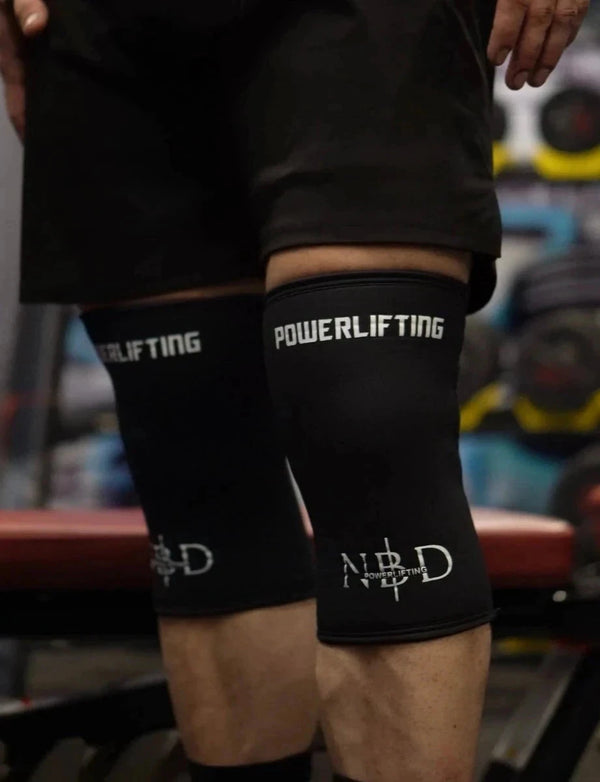
NBD sleeves are built to that dimensional specification — 7mm thickness, 30cm length. To be precise about what that means: meeting the dimensional specification is not the same as appearing on a federation's approved-equipment register, and NBD is not currently listed on one. Confirm the current rulebook and equipment list for your specific federation before meet day.
Does Thicker Last Longer?
Not automatically, and this trips people up. Neoprene density and stitching quality decide how long a pair survives, not the millimetre count. A dense, well-stitched 5mm sleeve will comfortably outlast a cheap foam-backed 7mm one that felt soft and comfortable out of the packet — softness on day one is the warning sign, not the selling point.
What actually determines lifespan is care. Hand wash cold with mild soap, air dry away from direct heat, never a washing machine and never a tumble dryer. Heat permanently destroys neoprene's compression and it does not come back. Turn them inside out after training instead of leaving them balled up damp in a gym bag — in Indian humidity that single habit is worth an extra year on a pair.
Should You Own Both?
Eventually, plenty of lifters do — 7mm for squat day and meet prep, 5mm for accessory work, conditioning and long sessions. That split is genuinely useful once your training has clearly separated into heavy days and everything else.
It is not a starting position. Buy one pair matched to how you train now, wear it properly, and add the second when you notice yourself actively wanting it. Buying both up front usually means one pair sits unused.
The Decision, Compressed
- Heavy squats are the centre of your training → 7mm
- Mixed training, high reps, conditioning, heat → 5mm
- Competing or peaking → 7mm, and check your federation's current equipment list
- Whichever you choose, size it tight — this matters more than the thickness decision
- Check the length spec is 30cm, not 27cm
- Hand wash cold, air dry, no heat, ever
5mm or 7mm — Both Built Properly
Dense neoprene, 30cm competition-specification length, reinforced stitching, sold as a pair. Free pan-India shipping and COD available. Not sure on sizing? Message the team with your measurements before you order.
SHOP NBD KNEE SLEEVES →Frequently Asked Questions
Is 7mm always better than 5mm?
No. 7mm is more specialised, not universally better. It gives more compression, more warmth and real rebound out of the bottom of a squat — which is exactly what makes it uncomfortable for high-rep work, conditioning or a long mixed session. If heavy squatting is not the centre of your training, 5mm is the more useful pair.
Can I use 7mm knee sleeves for CrossFit?
You can, but most people do not enjoy it. 7mm is stiff by design and runs hot, which becomes a problem across a long metcon or anything with running, box jumps or double-unders. 5mm gives warmth and light compression with far more freedom to move. Some athletes own both and switch by session.
Which thickness is legal in powerlifting competition?
Under current IPF rules the maximum permitted thickness is 7mm and the maximum length is 30cm, so both 5mm and 7mm fall inside the thickness limit. Federations also maintain their own approved-equipment registers — check the current rulebook and equipment list for your specific federation before meet day.
Do 5mm knee sleeves give any rebound?
Very little. 5mm provides warmth and light compression but does not store and return meaningful elastic energy out of the bottom of a squat. If you are buying sleeves to feel more supported on heavy squats, 5mm will disappoint you.
Should I buy both 5mm and 7mm?
Once your training clearly splits into heavy days and everything else, yes — 7mm for squat day, 5mm for the rest. It is not a starting position. Buy one pair matched to how you train now and add the second when you want it.
Does a thicker knee sleeve last longer?
Not automatically. Density and stitching matter far more than thickness. A dense, well-stitched 5mm sleeve outlasts a cheap foam-backed 7mm one. Care is what actually decides lifespan — hand wash cold, air dry, no heat.
Related reading: Best knee sleeves for squats in India 2026 · Knee sleeve size guide · Knee sleeves vs knee wraps · Choosing your first powerlifting kit